
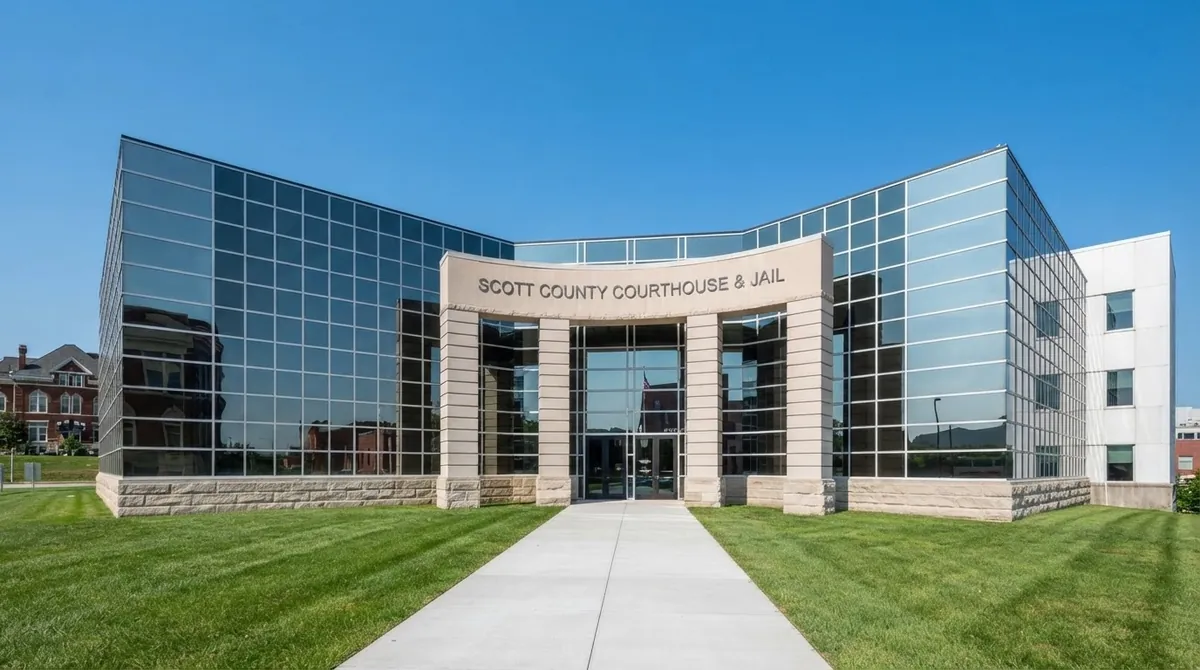
Court records in Scott County, Iowa, are maintained by the Clerk of the District Court and are accessible through online tools, official court portals, and directly at the court clerk's office. ScottIACourt.us can help find public information about county court records. Additionally, you can use the Iowa Judicial Branch portal, contact the court clerk's office, or use other state resources to obtain the necessary documents.
Scott Court System Overview
Scott County is part of the 7th Judicial District of Iowa. This district also serves Clinton, Jackson, and Muscatine counties. The District Court is a court of general jurisdiction, and the Magistrate Division operates within it, handling smaller-scale cases.
The main courthouse of Scott County is located in Davenport:
District Court judges are assigned to cases through the administrative system of the 7th Judicial District. Magistrate judges handle less complex criminal and civil cases right in the same courthouse.
Courts Serving Scott
Iowa District Court
Magistrate Division
U.S. District Court — Southern District of Iowa
Scott County falls under the jurisdiction of the Southern District of Iowa, Davenport Division.
Federal Bankruptcy Court
What Types of Cases Scott Courts Hear
Scott County courts hear a wide range of cases. Here are the main categories:
- Criminal cases: felonies, misdemeanors, infractions
- Civil cases: claims of any amount, including small claims
- Family law: divorce, child custody, alimony, protective orders
- Probate: estate administration, guardianship, conservatorship
- Juvenile matters: delinquency proceedings, child protection, adoption
- Traffic violations and DUI
Details on each category are in the following sections.
District Court Cases in Scott
The District Court handles the most serious cases. This includes major criminal offenses after a preliminary hearing in the Magistrate Division, as well as civil claims where the dispute amount exceeds the magistrate's jurisdictional limit. Appeals from magistrate judges' decisions also go to the District Court.
Cases are distributed among judges through the administrative system of the 7th Judicial District. A District Court judge presides over all stages—from preliminary hearings to sentencing or judgment. Post-conviction proceedings (appeals, motions for reconsideration) are also handled at this level.
Magistrate Court Cases in Scott
The Magistrate Division is where most people first encounter the court system. It handles misdemeanors, minor infractions, traffic cases, and initial hearings in serious criminal cases.
Civil cases with claims up to $6,500 fall under the magistrate's jurisdiction. Small claims cases are heard with a dispute amount up to $6,500—the procedure is simplified, and an attorney is usually not required. Magistrate judges also conduct hearings on DUI arrests and bail settings. Due to the high volume of cases in Scott County, individual magistrates may specialize in certain categories—such as traffic violations or small claims.
Family Law, Probate, and Juvenile Matters in Scott
Family Law
Divorce, custody, alimony, and protective order cases are heard by the District Court. Information on divorce procedures can be found on the Iowa Judicial Branch divorce page. Paternity and termination of parental rights cases also fall under the jurisdiction of the District Court.
Probate
Estate administration of deceased persons, appointment of guardians and conservators, and trust matters are all processed through the District Court. The court clerk maintains the probate case register and issues the necessary documents.
Juvenile Matters
Juvenile proceedings (Juvenile Justice Act and Child Protective Act) are confidential. Scott County has a separate Juvenile Court Services operating within the District Court. Access to these case materials is restricted by law.
How Cases Move Through the Scott Court System
- Case Initiation. A criminal case begins with the filing of an indictment or complaint. A civil case starts with a petition. Documents can be filed through the eFile Iowa Judicial Branch system or in person at the clerk's office.
- Judge Assignment. The administrative system assigns the case to a specific judge.
- Initial Hearings. In criminal cases, this is an arraignment (charging and bail setting). In civil cases, it's a scheduling conference.
- Pretrial Phase. Parties exchange evidence and file motions. In criminal cases, plea negotiations may occur.
- Trial or Resolution. The case concludes with a jury verdict, judge's decision, settlement, or guilty plea.
- Post-Decision. Sentencing, appeal filing, or enforcement of the judgment.
Court Administration, Local Rules, and Public Access in Scott
The administrative judge of the 7th Judicial District coordinates the work of courts in Scott County. The Trial Court Administrator is responsible for the daily organization of the clerk's office.
Local court rules for the 7th Judicial District are available through the Iowa Judicial Branch website. The organizational structure and contact information can also be found there.
Regarding public access—court records in Iowa are generally open according to Chapter 22 of the Iowa Code. The Iowa Public Information Board explains the rules for accessing public documents. Some records have restricted access: juvenile cases, court-sealed documents, and records protected by privacy laws.
Hearings can be attended in person at the courthouse. In certain cases, the court holds remote sessions—check the possibility of online participation with the clerk's office at (563) 326-8783.
Court Records and Related Court Resources in Scott
- Online Case Search. The Iowa Judicial Branch portal allows searching court records through the Iowa Courts Online system (formerly Iowa Courts Information System). It provides case data, hearing schedules, and interactive forms.
- Electronic Document Filing. Through the eFile system, you can file civil documents and pay fees with a credit or debit card.
- Court Clerk's Office. Requests for copies of court records are accepted in person or by mail. Certified copies require a fee.
- Criminal History Check. The criminal history check request is processed by the Division of Criminal Investigation (DCI) at the Iowa Department of Public Safety. Requests can be submitted by mail, fax, in person, or email—details on the DCI page.
- Inmate Search. The Iowa Offender Search allows finding information about individuals serving sentences or on parole. Additional information for relatives is provided by the Iowa Department of Corrections.
- Vital Records. Birth, death, and marriage certificates can be ordered through the Iowa Department of Health and Human Services or the Iowa.gov portal. Records before 1954 (marriages) and before 1880 (births, deaths) should be requested from the appropriate county office.
- IOWA System (Iowa On-line Warrants & Articles). The IOWA Network provides information to law enforcement agencies, but certain data may be available upon request.
- Court Self-Help. The Iowa Judicial Branch offers interactive forms and resources for individuals representing themselves—all available on the main site.